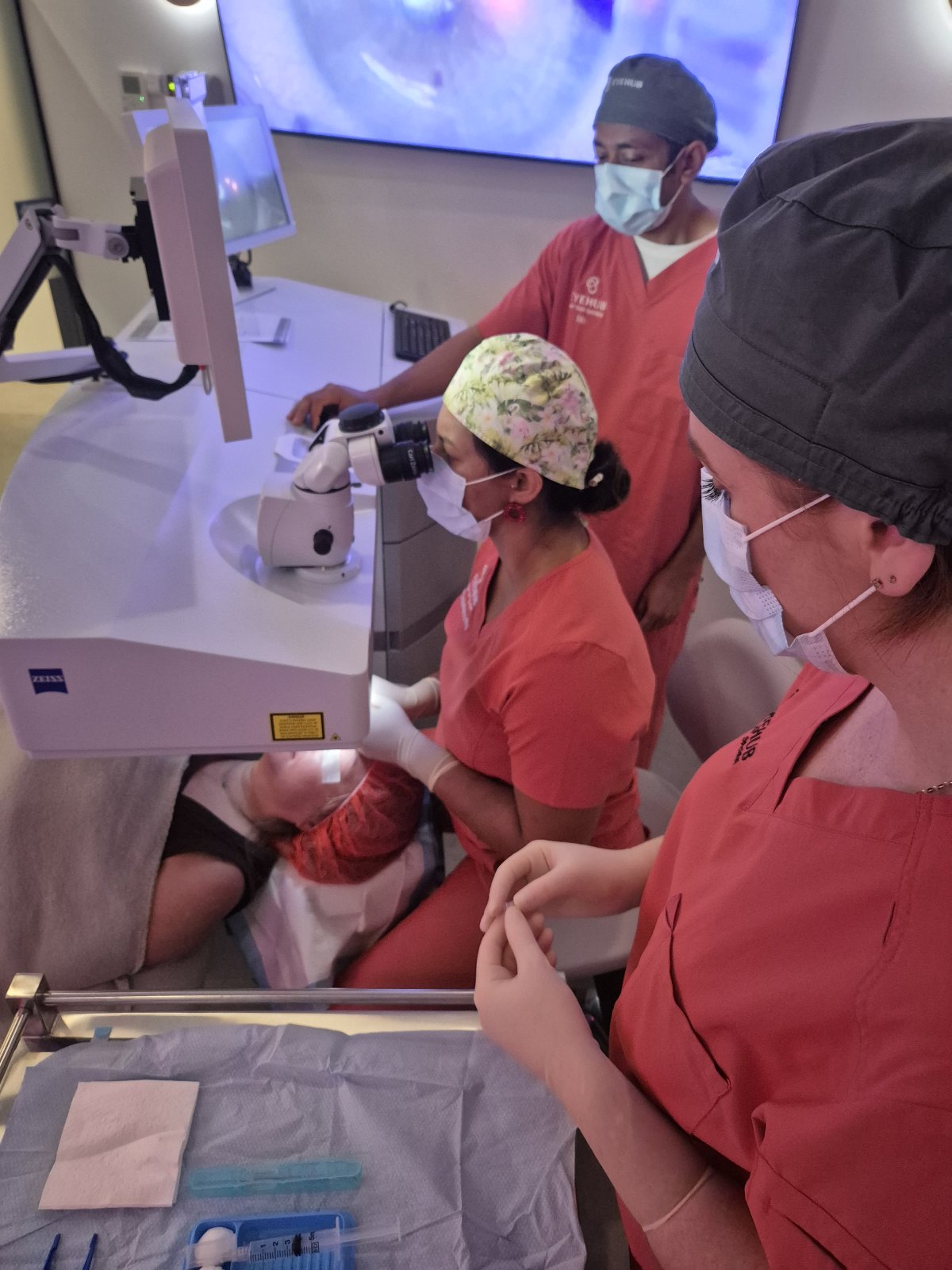
What is Refractive Lens Exchange?
Refractive lens exchange (RLE) replaces the eye’s natural lens with an artificial intraocular lens (IOL). The operation is technically similar to modern cataract surgery, but it is planned for refractive reasons, often before a cataract is affecting your vision. Depending on the lens chosen, you may rely less on glasses for distance, intermediate and/or near tasks.
At EyeHub, Dr Sonia Moorthy discusses RLE alongside laser options such as PRESBYOND, SMILE PRO (also known as SMILE) and LASIK, and lens-based alternatives such as ICL, when measurements and age make those procedures relevant. This guide covers suitability themes and lens categories. It is not a personal implant recommendation.
Any surgical or invasive procedure carries risks.
Who RLE may suit
RLE is usually considered for people over 40, especially if your prescription is outside the usual laser range or early lens changes have started. If your natural lens is still clear and flexible, laser or an implantable contact lens is usually discussed first. RLE can also be discussed for people who are not suitable for laser vision correction. Common reasons it enters the conversation:
- Presbyopia: difficulty focusing up close as the natural lens stiffens
- Early lens changes that don’t yet qualify for Medicare-funded cataract surgery
- Higher long-sightedness or other refractive profiles where corneal laser is less suitable
- A preference to address distance and near needs with a lens-based plan after counselling
RLE is usually not the first discussion for younger adults whose natural lens still focuses well up close, because removing a flexible lens means losing that focusing ability. Very high short-sightedness without presbyopia also needs careful counselling, because the risk of retinal detachment after lens surgery is higher in very short-sighted eyes, especially in people under about 50. Active macular disease, uncontrolled glaucoma or other findings can also steer care elsewhere.
For people over 40, the choice between PRESBYOND, RLE and other options is often case by case. Your assessment decides, not an age band alone.
Lens categories
The IOL you and your surgeon choose shapes the range of clear vision and the trade-offs you may notice (especially at night). EyeHub discusses categories in counselling.
| Category | Typical aim | Common trade-off to discuss |
|---|---|---|
| Monofocal | Clear focus at one planned distance (often far) | Reading glasses likely for near unless monovision / blended strategies are planned |
| Extended depth of focus (EDOF) | Distance plus intermediate (screens, dashboard); some near | Fine print or dim light may still need readers |
| Multifocal / trifocal | Distance, intermediate and near range for selected patients | More discussion of halos, glare and contrast; how much you want to be free of glasses matters |
| Toric versions | Any of the above plus astigmatism correction | Needs precise alignment; residual cylinder possible |
Motivation, night driving, occupation and personality around optical symptoms matter as much as the brochure range.
Results and adjustment
Many people adapt over weeks to months as the brain settles to new optics, especially with extended depth of focus (EDOF) lenses or multifocal designs. EyeHub has its own Mindtrain App, which you can use before and after surgery while you adjust. In some cases, a small residual prescription can remain; further options are clinical and cannot be guaranteed. We’ll discuss it if it happens.
Risks (overview; full list at consent)
Serious problems are uncommon. UK eye-surgeon guidance (Royal College of Ophthalmologists) estimates that about 1 in 500 people have permanent, serious loss of vision in the treated eye after RLE. That means vision that can’t be corrected to driving standard with glasses, or in rare cases loss of sight in that eye. This is more common than after laser or an implantable contact lens. Retinal detachment is also more likely after lens surgery, especially in the first few years and in very short-sighted eyes, and the extra risk doesn’t completely go away. New floaters, flashes of light, or a shadow or curtain across your vision need same-day care. Counselling includes infection inside the eye, retinal detachment (discussed carefully in higher myopia), raised pressure, refractive surprise, optical symptoms (halos/glare), and the possibility of further procedures. Your written consent covers material risks for your eyes.
Cost structure at EyeHub
RLE pricing is explained in two layers:
- Surgeon’s fee: the clinical package discussed with you.
- Hospital and anaesthetic fees: additional, confirmed at the time of surgery.
| Item | Cost |
|---|---|
| RLE or ICL surgeon’s fee | $3,500* per eye |
| RLE or ICL hospital and anaesthetic fees | On top, confirmed at the time of surgery |
| RLE approximate total, both eyes | About $12,500 to $13,000 (may vary by hospital and anaesthetist) |
*Prices are subject to change without notice.
Aftercare and post-op reviews for 12 months apply to RLE (as they do for LASIK, SMILE PRO, PRESBYOND and ICL). Your written quote confirms the exact package wording.
For comparison, our laser fees for both eyes are PRESBYOND $8,800*, SMILE PRO $7,500* and LASIK $7,500*. Elective clear-lens RLE is generally not covered by Medicare; private health fund help depends on your policy, so check with your fund.
Assessment procedure
RLE uses the same laser vision assessment procedure:
- Free online video assessment
- In-person assessment with a $100 deposit (redeemable against your surgery; refunded if you are unable to proceed for medical reasons)
You will meet Dr Moorthy and discuss your options together. Once you are happy with the plan, we can book your surgery.
From first call to surgery is typically about two weeks when you proceed, subject to clinical readiness and theatre scheduling.
Comfort: RLE is commonly performed as day surgery with local anaesthetic drops; hospital and anaesthetic arrangements (including any twilight sedation) are confirmed for your case. Most people describe a slight pressure.
Clinics in Buderim (Unit 1, Building A, 23 Elsa Wilson Dr, Buderim QLD 4556) and Noosaville (197 Weyba Road, Noosaville QLD 4566).
FAQs
Is RLE the same as cataract surgery?
Technically similar surgery; the indication differs. Cataract surgery treats a cloudy lens (often with a Medicare rebate). Elective RLE on a clear or early-change lens is planned for refractive goals and is generally not Medicare-funded.
Will I still need glasses?
It depends on the lens category and your eyes. In some cases, people may use glasses for some tasks.
Can I have had LASIK before and still have RLE later?
Often, yes. Lens calculations are planned differently after prior laser. Tell us your surgical history at assessment.
Both eyes same day?
Staging is a clinical decision. Your surgeon will advise what suits your health and recovery plan.
Next step
Email laser@eyehub.net.au to start with a free online video assessment, or book online. You can also call our laser coordinators on 1800 EYEHUB. Bring notes about night driving, screen work and reading hobbies, because choosing a lens is as much about your lifestyle as the optics.
Prices are subject to change without notice. Any surgical or invasive procedure carries risks.