Refractive lens exchange cost in Australia (2026)
Refractive lens exchange (RLE) replaces the eye’s natural lens with an intraocular lens (IOL). People often compare it with laser vision correction when they are over 40, have early lens changes, or are not suitable for corneal laser. Cost questions come up quickly, and for good reason. RLE usually involves a surgeon fee plus hospital and anaesthetic components.
This article explains how EyeHub talks about RLE cost on the Sunshine Coast, what is typically included in the clinical package, and which parts of the bill sit outside the doctor’s fee. It is not a personal quote.
Any surgical or invasive procedure carries risks.
Doctor’s fees versus hospital and anaesthetic
At EyeHub, RLE pricing is explained in two layers:
- Doctor’s / surgeon-related fees: the clinical package for assessment, surgery by Dr Sonia Moorthy, and the agreed IOL discussed with you.
- Hospital and anaesthetic fees: facility and anaesthesia costs that are additional and confirmed at the time of booking.
Doctor’s fees: $3,500* per eye ($7,000* both eyes). This covers doctor’s fees only. Hospital and anaesthetic are additional and confirmed at booking.
*Prices are subject to change without notice.
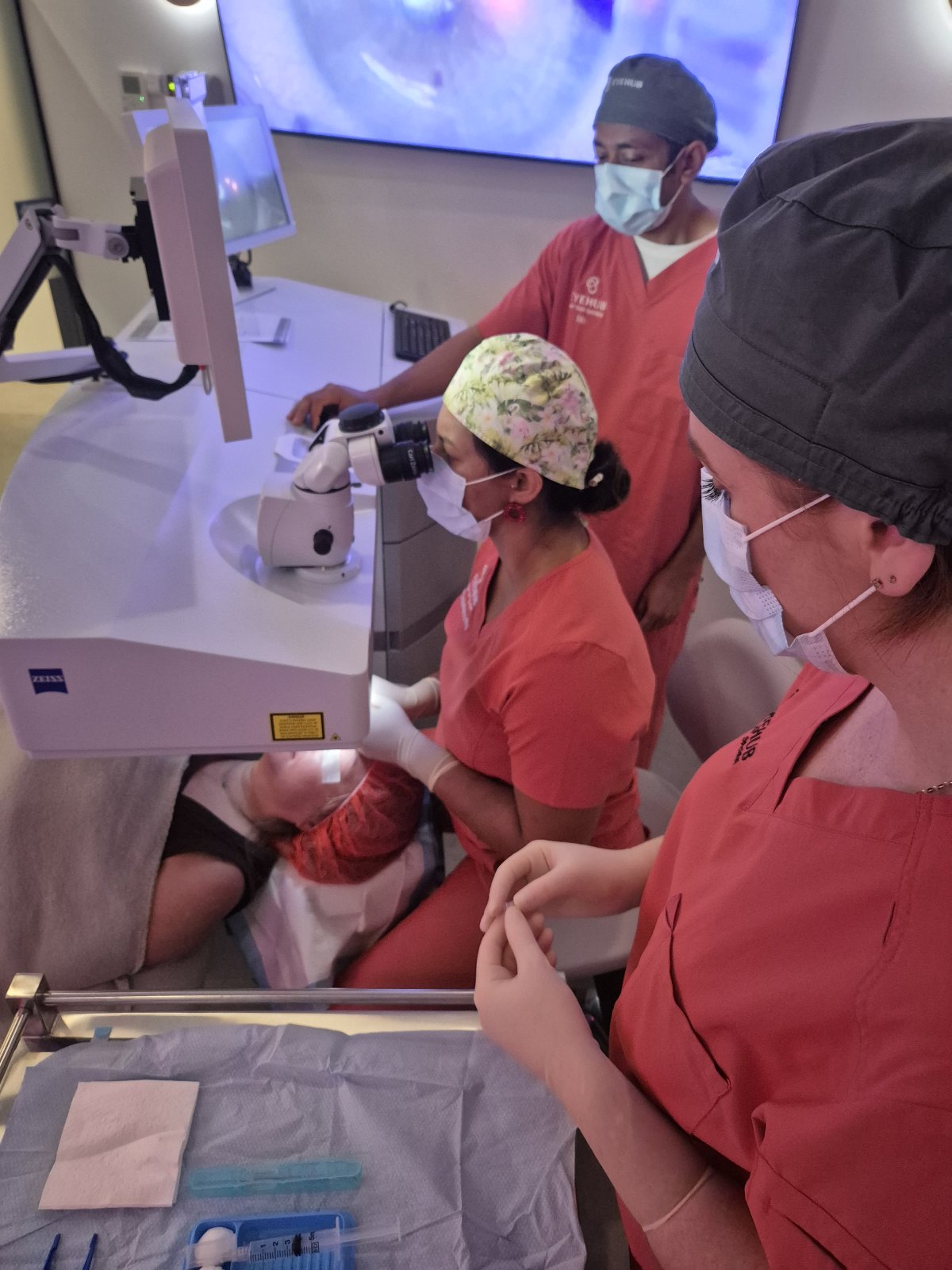
The RLE landing page also notes that comprehensive pre-operative assessment and diagnostics, a premium IOL tailored to your needs, and surgery by Dr Moorthy (FRANZCO) sit within the clinical offer described there. Aftercare and post-op reviews for 12 months apply to RLE, as they do for LASIK, SMILE PRO, PRESBYOND and ICL. Confirm the exact package wording on your written quote.
Enhancements: for RLE, enhancements are offered if applicable, after further assessment. They are not an automatic inclusion.
Why RLE quotes differ between clinics
Published RLE figures across Australia are hard to compare at a glance because:
- Some clinics bundle hospital and anaesthetic into one number
- Others show surgeon-only fees and add facility costs later
- Lens type (monofocal, extended depth of focus, multifocal / trifocal, toric options) changes cost
- One eye versus both eyes, and staging, changes totals
When you compare, ask for a line-by-line breakdown: surgeon, lens, hospital, anaesthetic, included reviews, drops or medications if charged separately, and any possible further procedures (for example YAG capsulotomy if posterior capsule opacification develops later, discussed clinically if needed).
Who RLE may suit
EyeHub’s RLE page describes it as designed for people over 40, or for people who are not suitable for laser vision correction. It may be discussed when the natural lens is losing flexibility (presbyopia / dysfunctional lens changes) and glasses or contacts are becoming harder to manage.
RLE is not the same as cataract surgery performed for a cloudy lens under Medicare. Elective RLE on a clear lens is generally not covered by Medicare. Private health fund contributions depend on your policy. Check with your fund.
Laser options such as PRESBYOND, SMILE PRO (also known as SMILE) and LASIK remain alternatives when clinically appropriate. Your assessment decides the procedure, not a blog post.
Assessment procedure at EyeHub
RLE uses the same laser vision assessment procedure as LASIK, SMILE PRO, PRESBYOND and ICL:
- Free online video assessment
- In-person assessment with a $100 deposit (redeemable against your surgery; refunded if you are unable to proceed for medical reasons)
Once you decide to go ahead, you see the doctor for a consult. That consult is free, and your surgery date is set then.
From first call to surgery is typically about two weeks when you proceed, subject to clinical readiness and theatre scheduling. Surgery deposits for the procedure itself are advised at consultation and/or surgery booking. Do not confuse this with the $500 surgery deposit used for general ophthalmology, which is non-refundable, unless you are unable to proceed for medical reasons.
Clinics: Buderim (Unit 1, Building A, 23 Elsa Wilson Dr, Buderim QLD 4556) and Noosaville consulting at 197 Weyba Road, Noosaville QLD 4566.
Comfort and recovery
RLE is commonly performed under local anaesthetic drops with twilight sedation as arranged for your case. Most people describe a slight pressure. Recovery timelines vary. Dr Moorthy will explain expected recovery, drops and activity limits at your assessment. We do not promise pain-free surgery or guaranteed spectacle independence.
Paying for RLE
Card and bank transfer are accepted. Third-party options on our payment plans page include MediPay, Afterpay, Zip Pay / Zip Money and TLC. EyeHub is not a credit provider and does not offer credit ourselves. Check provider terms separately.
Health funds may contribute in some cases. Confirm with your fund before you commit.
FAQs
Does the $3,500* per eye include hospital?
No. Treat hospital and anaesthetic as extra unless your written quote explicitly bundles them. The $3,500* per eye covers doctor’s fees only.
Will I need two visits?
Eyes may be planned according to clinical advice. Your surgeon will explain whether treatment is staged and how that affects cost and recovery.
How does RLE cost compare with ICL or laser?
They are different operations with different packaging. Live laser and ICL figures are on our pricing page. RLE should be compared using a full quote, not a single headline number.
Does Medicare cover elective RLE?
Generally no for elective clear-lens RLE. Confirm any fund or Medicare questions with the relevant organisation and our team for coding context only.
Next step
Book an assessment or email laser@eyehub.net.au to talk through whether RLE or another option may suit you. Call our laser coordinators on 1800 EYEHUB. Your written quote after assessment is the figure to budget against.
Prices are subject to change without notice. Any surgical or invasive procedure carries risks.